How to Choose Desktop CNC Router Bits

In CNC machining, the machine provides the power, but the cutting tool is what truly interacts with the material. Choosing the right CNC tool has a major impact on machining quality, cutting speed, surface finish, tool life, and even machine wear.
Tool selection is not magic or guesswork—it follows a rigorous matching logic based on material, process, and size. This article breaks down CNC tool selection using four core dimensions:
- Understand key parameters: Learn the "ID card" of a tool—shank diameter, cutting diameter, overall length, flute length, flute count, cutting edge design, and corner radius—all of which directly influence cutting efficiency, surface quality, and tool life.
- Recognize shape and purpose: Review common CNC tool types and their dedicated use cases, including end mills, ball nose end mills, V-bits, corn mills, drill bits, flat end mills, bull nose end mills, chamfer tools, and thread mills.
- Read coating "armor": Explain the protective principles behind uncoated, TiN (gold), TiCN (bronze/bronze-like), AlTiN (purple-black), and DLC (usually black or dark gray).
- Beginner tool recommendations: Provide a ready-to-use set of 9 beginner "go-to" tools that covers most common desktop CNC projects, from engraving and 3D carving to aluminum machining and basic drilling.
Once you master this logic—choose coatings and flutes by material, choose tool geometry by process, and set dimensions by your machine and drawing—you will no longer feel tool-selection anxiety. You can start producing high-quality CNC work confidently.
Tool Basic Parameters
Before choosing a tool, you must understand what the numbers and symbols on the tool mean. These parameters are like the tool's "ID," telling you what it can do and how it performs. Each parameter affects how the tool performs and helps you choose the right tool for different machining tasks.
Shank Diameter
The shank diameter is simply the diameter of the part of the tool that inserts into the machine. It primarily relates to collet/holder compatibility, and it has little direct impact on machining precision.

Common shank sizes include 1/8", 4mm, 6mm, 1/4", etc.
Why it matters:
- The shank diameter must match your CNC machine's collet/toolholder system.
- If your machine only supports 4mm shanks, you cannot use a 6mm-shank tool.
- A mismatch can lead to poor clamping, misalignment, excessive runout, vibration, and even tool breakage.
Beginner tip: Many desktop CNC machines use 1/8" (3.175mm) shanks, while some models support 4mm or 6mm tool systems. Collet reducers can allow smaller shank tools to fit larger collets, but they should only be used with proper-quality reducers to maintain clamping accuracy and ensure the tool remains properly clamped.
Cutting Diameter
Cutting diameter is the diameter of the part that actually cuts the material. This is often the key parameter for machining detail and accuracy—not the shank diameter.

Some tools have a different cutting diameter than their shank diameter. In that case, you must look at the cutting diameter.
Why it matters:
- Cutting diameter determines how wide the tool can cut and how finely it can trace details.
- If the cutting diameter is larger than the width of the detail you need, you will lose definition.
Overall Length
Overall length is essentially the "height" of the tool—from the very tip to the end of the shank. It is typically 50–100mm.

Why it matters:
- Overall length must fit your machine's spindle nose and your Z-axis travel.
- If the tool is too long, it increases the overhang length, causing tool "wobble," vibration, worse precision, and shorter tool life.
- If it is too short, it may not reach the material or could collide.
Beginner golden rule: Choose a shorter tool whenever possible. Only use longer tools for deep pocketing or thick material machining.
Flute Length
Flute length is the length of the cutting portion (the helical/grooved area). It determines the maximum effective cutting depth.

Key idea:
- If a tool has 10mm flute length, you generally cannot cut the full 10mm depth; you should reserve a safety margin.
- As a general guideline, flute length should be slightly longer than the cutting depth you need, while avoiding unnecessary extra length.
Why it matters:
- Too long flute length reduces rigidity and increases vibration risk.
- Too short flute length can increase friction between the holder/shank and the workpiece, causing heat and discoloration.
Flute Count: Choosing 1-Flute, 2-Flute, 3-Flute, and 4-Flute CNC Tools
Most desktop CNC machines commonly use 1-flute, 2-flute, and 3-flute tools. The right flute count depends mainly on material type, chip evacuation, cutting speed, and machine rigidity.

Typical guidance:
- 1 flute: Excellent chip evacuation and low cutting resistance; commonly used for plastics, acrylic, and aluminum machining on compact CNC machines where chip removal is critical.
- 2 flutes: The most versatile option for wood, plastics, and general-purpose machining. It provides a good balance between cutting efficiency and stability.
- 3 flutes: A strong choice for aluminum machining, offering a balance between rigidity, chip evacuation, and surface finish.
- 4 flutes: Provides higher rigidity and better finishing capability, but usually requires stronger spindle power, higher machine rigidity, and better chip evacuation.
Beginner tip:
- For wood, plastics, and acrylic, start with 1–2 flute tools.
- For aluminum on desktop CNC machines, 2–3 flute tools are usually a better choice. Four-flute tools are more common on rigid industrial machines.
- Fewer flutes provide more chip space, which helps with sticky materials and high material removal. More flutes improve rigidity and finishing when machine power and cutting conditions are sufficient.
Introduction to Common Tools
Now that you understand the basic tool parameters, here are common CNC tool types and what each is best at, including key suitability notes.
End Mill
"Universal tool"—one of the most common CNC tools. Unlike drill bits, end mills can cut both vertically and sideways, making them the foundation of CNC milling operations.

- Spiral flutes like a "rotating drill"
- Capable of cutting, engraving, and milling
- Available in multiple flute counts (1/2/3/4) for different needs
1-Flute End Mill
Structure: a large single helical chip flute; very sharp cutting edge.

- For acrylic: cleaner cuts, less whitening, and smooth and clear edges
- For plastics: fewer burrs, reduced sticking
- The large flute space helps reduce chip clogging and heat buildup during cutting.
Best for: Acrylic, PVC, PP, ABS, resin, foam, and other soft/brittle materials
Shortcomings: Lower material removal rate per unit time; More sensitive to high feed rates and may cause vibration if not matched properly.
Recommended: Single Flute Spiral End Mill for Non-Metallic Use | Single Flute Spiral End Mill for Metal Use
2-Flute End Mill
Structure: symmetric double helical flutes; balanced rigidity.


- Works across soft and hard materials
- Wood cuts cleanly without chipping
- Plastics do not burn easily
- Light aluminum cutting is possible
- Better stability: reduced vibration and improved machining consistency.
Best for: Solid wood, MDF, plywood, multilayer boards, plastics, soft aluminum, foams
Shortcomings: Fine finishing on high-hardness steel is typically not as good as 3–4 flute tools; High-gloss metal finish may not be ideal.
3-Flute End Mill
Structure: equally spaced 3 cutting edges; chip evacuation, rigidity, and smoothness are balanced.


- Optimized for aluminum cutting
- Less sticking and lower risk of pulling/snagging
- Balanced cutting forces can help achieve smoother surfaces and more consistent machining results.
Best for: Aluminum alloys, aluminum profiles, copper alloys, magnesium alloys, hard wood, high-density composites
Taboo: Not ideal for acrylic (vibration artifacts may appear); Not recommended for steel machining on most desktop CNC machines due to machine rigidity and spindle power limitations.
Ball Nose End Mill
A "round-tip tool" for 3D carving. It is the go-to tool for relief and 3D surface machining.


Key characteristics: A rounded tip like a small ball.
Core capabilities: Machining complex 3D surfaces; Smoother surface with fewer steps compared to flat tools; Relief and 3D textures become feasible.
Core concept: Surface detail and smoothness depend on the ball radius.


- Smaller ball radius: finer detail and smoother curvature, but slower.
- Larger ball radius: faster and smoother overall blending, but fewer tiny details.
Common process workflow:
- Use a larger flat end mill for rough removal
- Switch to a smaller ball nose
- Run finishing toolpaths with smaller stepovers/feeds for smoother curved surfaces.
Typical uses: 3D portraits, Relief patterns, Curved parts, Molds and models.
V-Bit
A "V-shaped engraving tool" for fine lettering and line patterns.


Key characteristics: Sharp V tip; Available in angles such as 30°, 45°, 60°.
Core advantages: Very fine letters and lines; Can produce both V-groove (V-shaped) effects for "engraving"; Different angles provide different line widths and depth profiles.
Angle guidance:
- 30°: ultra-fine lines and very small text (often under ~5mm)
- 45°: balanced, generally the beginner best choice
- 60°: thicker lines, larger bevels, and deeper signage grooves
Required process: All text engraving should use a "finishing/cleaning" strategy ("finish pass") to remove scallops and tool marks.
Common uses: Small text and engraving, Stamps and nameplates, Fine patterns, Bevels and small chamfer-like effects.
Corn Mill (Serrated Tool)
A "serrated cutter" designed for composite materials and abrasive laminates where chip control and delamination prevention are important.

Key characteristics: Many serrated cutting edges like a corn cob.
Advantages: Break-up cutting helps cut hard materials; Excellent chip evacuation; low risk of chip packing and burnt chips; Helps avoid delamination on multi-layer boards and prevents tearing.
Common uses: Cutting PCB boards, Carbon fiber machining, Cutting multilayer composite boards, Hard plastic processing.
Recommended: Corn Milling Cutter
Drill Bit
A "drilling specialist" used for holes only. It should not be used for milling slots or side cutting.


Key characteristics: Screw-like body with cutting lips.
Advantages: Fast and stable drilling; Good center guidance and hole accuracy; Suitable for many materials.
Important restriction: On desktop CNC machines, drill bits should generally be used for vertical drilling rather than side cutting. Lateral cutting/contouring with a drill bit will quickly cause tool breakage.
Common uses: Drilling holes in wood, Drilling plastic sheets, Producing assembly locating holes.
Flat End Mill
A "flat tool," one of the most basic and widely used CNC tools for finishing flat surfaces.


Core characteristics: A flat bottom end for flat surface and step machining; Multiple flutes for different stability needs.
Advantages: Great for flat milling, steps, and slot base cleanup; Even cutting force; stable machining; Supports high-precision flat parts; Flute count can be selected (2-flute / 4-flute).
Flute selection:
- 2 flutes: General purpose machining, wood, plastic, and light aluminum
- 3 flutes: Better choice for aluminum finishing on compact CNC machines
Common uses: Flat surface milling, Steps and pockets, Base cleanup, Flat part machining.
Bull Nose End Mill
A flat end mill variant with a built-in radius at the tip. It helps reduce corner chipping and improves cutting stability in deep pockets and tight areas.


Core purpose: Solves interference problems where sharp corners of a flat tool would collide with pocket walls/side walls.
Typical benefits: Smooth cutting in deep slots and thin-wall work; Protects edges and avoids overcutting or tool scraping.
Common uses: Thin-wall parts, Deep or narrow slots and complex inner features, Molds and complex cavities, Parts that require edge protection and chipping resistance.
Chamfer Tool
A "chamfer specialist" for edge chamfering and deburring to make edges smooth, safe, and visually clean.


Key characteristics: Often a multi-flute (e.g., three-flute) design with fixed angles; Efficient and consistent chamfer generation.
Common angles: 90° (most common; beginner-friendly); 45° (for special chamfer needs).
Typical uses: Deburring and rounding edges, Chamfering hole mouths for easier assembly and reduced stress concentration, Making conical and sloped features, Improving overall appearance and safety.
Thread Mill
A "thread specialist" for internal and external threads with high precision and flexibility.


Core advantages: Threads via CNC helical interpolation; More flexible than taps and often longer-lived; Lower cutting force; less risk of tool snapping compared with taps.
Key guidance: Recommended minimum thread size is M3 and above. Below M3, threading becomes difficult and breakage risk increases significantly for beginners.
Common uses: Internal threads (blind or through holes), External threads, Repairing damaged threads, Making non-standard threads and special pitches.
Tool Coating Knowledge
Beyond geometry and parameters, the "outer armor"—coating—is also critical to tool performance. Coatings are like high-performance "armor" that help a tool stay sharp under heat, pressure, and cutting loads.
What coatings change:
- ✅ Wear resistance: reduce abrasive wear so the cutting edge lasts longer
- ✅ Thermal stability: protect against high-temperature softening and hot wear
- ✅ Oxidation / chemical stability: reduce chemical reactions and diffusion wear at high temperatures
- ✅ Low friction / anti-sticking: reduce sticking and built-up edge (BUE), especially for difficult materials like aluminum and copper
Common Coating Systems and Their Differences
⚪ A. Uncoated

Features: no extra film; relies on the carbide substrate.
Advantages: lowest cost; less demanding process requirements.
Limitations: shorter life under high temperature, heavy abrasion, or strong BUE conditions.
Suitable for: wood, plastics, wax-like materials, and light-duty machining.
🟡 B. TiN (Titanium Nitride)

Appearance: gold / yellowish.
Goal: general wear resistance and stable performance.
Advantages: good wear suppression, broad process adaptability, affordable.
Limitations: anti-sticking capability is usually weaker for strong sticking materials like aluminum.
Suitable for: general metal cutting when you prioritize durability and cost-effectiveness.
🟣 C. TiCN (Titanium Carbonitride)

Appearance: bronze-colored.
Goal: harder and more wear-resistant composite direction.
Advantages: higher hardness than TiN and better resistance in a temperature range.
Limitations: in very sticky aluminum high-MRR conditions, it still may not match low-friction coatings like DLC.
Suitable for: medium-hard materials and cutting tasks sensitive to wear.
D. TiAlN / AlTiN (Titanium Aluminum Nitride)

Appearance: usually violet-gray, purple-black, or bronze depending on composition and manufacturer.
Goal: high-temperature oxidation resistance + wear resistance.
Why the color? multi-layer structures and thin-film interference create visual color.
Advantages: better high-temperature tolerance; generally longer life than TiN/TiCN; excellent cost-performance for general metal cutting.
Limitations: aluminum machining may still produce BUE; correct chip evacuation and tool geometry still matter.
Suitable for: steel, stainless steel, and cast iron where high temperature + wear resistance are both important.
🌑 E. AlCrN / Multi-component High-Temperature Coatings

Appearance: usually darker.
Goal: stronger high-temperature stability and oxidation resistance.
Advantages: especially stable under high-temperature cutting; excellent oxidation resistance.
Suitable for: cast iron and heat-resistant materials or processes that commonly reach high temperatures.
F. Multilayer / Nano-multilayer

Goal: combine multiple properties via layer structure rather than optimizing a single metric.
Advantages: better overall tool life; improves tolerance for slightly unstable cutting parameters and varying chip loads.
Suitable for: users whose processes fluctuate and need more stable tool behavior.
G. DLC (Diamond-Like Carbon)

Positioning: "king of low friction and anti-sticking."
What you feel: tools are less prone to gumming up on sticky materials, producing more stable surface quality and less dimensional fluctuation.
Advantages: extremely low friction and strong anti-sticking behavior for aluminum/copper-like materials.
Limitations: coatings are typically thin; they still suffer under impact loads and temperature rise caused by poor chip evacuation.
Suitable for: aluminum (especially when surface quality matters), copper, brass, and other high-sticking materials.
How to Choose the Right Coating?
- Wood, plastic: Uncoated or TiN coating is sufficient, cost-effective
- Aluminum alloy, copper: DLC coating for best anti-stick performance, TiCN as alternative
- Stainless steel, steel: AlTiN or TiAlCN coating, high temperature wear-resistant
- High-temperature alloys: AlCrN or multilayer coatings
Beginner Tool Selection Guide: 9 Essential CNC Tools
As a CNC beginner, choosing a suitable tool is the first step. A good tool makes machining smoother and boosts confidence. Below are 9 beginner-friendly essential tools covering over 90% of common desktop CNC machining scenarios, helping you start CNC work effectively.
1. 1/8" Corn Mill

Appearance: serrated cutting edges like a corn cob.
Why it fits beginners: Excellent chip evacuation; Solves delamination problems; High tolerance for parameter errors.
Common uses: Carbon fiber machining, Composite boards, Fiberglass materials, Hard plastics.
Beginner tip: reduce feed rate slightly so the tool can fully utilize its break-up cutting advantages.
👉 Buy now: Corn Mill
2. 1/8" Double-flute Ball Nose End Mill

Appearance: a perfect hemispherical ball tip with helical flutes.
Why it fits beginners: Works on soft and hard materials; Great for 3D surface and relief processing; High stability due to symmetric flute design.
Suitable for: 3D portrait carving, Relief pattern making, Curved parts, Mold and model finishing.
Beginner tip: smaller ball radius gives more detail but slower machining. Beginners can rough with a larger ball nose, then finish with a smaller ball nose.
👉 Buy now: Double Flute Ball Nose End Mill
3. 1/8" Single-flute Helical End Mill (DLC coating)

Appearance: one wide helical chip flute and a black DLC coating.
Why it fits beginners: Great cutting results (less chipping on acrylic); No sticking due to low friction; No chip-clog stress due to large flute space.
Suitable for: Precision acrylic cutting, Plastic precision machining, Engraving on acrylic (PMMA), Resin material processing.
Beginner tip: use relatively higher spindle speeds and a moderate feed rate to keep the cutting edge operating efficiently.
👉 Buy now: Single Flute Spiral End Mill (DLC)
4. 1/8" Three-flute Helical End Mill (DLC coating)

Appearance: three evenly distributed helical cutting edges with DLC coating; typically deep black or rainbow-like.
Why it fits beginners: Aluminum "anti-sticking" specialist; Higher efficiency; Better surface finish.
Suitable for: Aluminum alloy parts, Aluminum profile slotting, Aluminum mold machining, Brass/copper alloy machining.
Beginner tip: for aluminum machining, use cooling/lubrication when appropriate to further improve surface quality and tool life.
👉 Buy now: DLC Three-Flute Spiral End Mill
5. 6mm Three-flute Helical End Mill
Appearance: thicker tool body (often available with advanced coatings optimized for aluminum machining).
Why it fits beginners: Rigidity increases dramatically; Extreme stability; Mirror-like sidewalls for side milling.
Suitable for: Aluminum alloy, Quick rough removal on hard wood, Outer contour cutting, Deep pocket opening/large slotting.
Beginner tip: use it only if your CNC supports a 6mm collet/clamping setup. Treat it as the "metal pioneer": remove the bulk material first, then switch to smaller tools for details.
👉 Buy now: 6mm Three-Flute Spiral End Mill
6. 1/8" Flat End Mill (TiN coating)
Appearance: flat cutting end; TiN coating typically appears gold/yellow.
Why it fits beginners: Highly versatile; Higher hardness and wear resistance; Simple to operate.
Suitable for: Flat surface milling, Step machining, Pocket floor cleanup, Outer contour milling.
Beginner tip: keep the tool cutting vertically and avoid heavy side loading to prevent breakage.
👉 Buy now: TiN Coated Flat End Mill
7. Drill Bit

Appearance: spiral drilling body with cutting lips; designed for drilling, not milling slots.
Why it fits beginners: Easy operation; Good center guidance; Suitable for many materials.
Suitable for: Drilling holes in wood sheets, Drilling plastic sheets, Assembly locating holes.
Beginner tip: use a slower feed to "spot" before full drilling to avoid slipping or walking.
👉 Buy now: PCB Drill Bit
8. Chamfer Tool
Appearance: typically with a V-shape front (often 90° or 60°), commonly with two to three cutting edges.
Why it fits beginners: Deburring and edge safety; Adds "industrial" quality; Optional locating aid.
Suitable for: Edge chamfering, Deburring hole mouths, Chamfering for countersink-like features, Locating marks.
Beginner tip: remove only a shallow amount at the edge—light contact is usually enough. You can feed a bit faster than you would for heavy milling.
9. 4mm Thread Mill

Appearance: shaped for a specific thread pitch, like a cylindrical "comb."
Why it fits beginners: One tool for multiple uses; Avoid broken tap issues; Fine control of tolerance.
Suitable for: Thread holes for assembly (e.g., M4, M5 and larger sizes), Thread milling in harder materials, Repairing damaged threads, Making non-standard threads and special pitches.
Beginner tip: thread milling must use the correct CNC/CAM thread-milling toolpath. You must pre-drill the bottom hole first (usually with a flat mill or drill).
👉 Buy now: 4mm Thread Mill
Why these 9 tools cover 90% of machining needs
This set is a "beginner starter toolkit." Their strengths are:
- Comprehensive coverage: from rough removal to fine details, from curved relief to drilling and chamfering to threading.
- High tolerance: the tools are designed to be workable even when parameters are not perfect.
- Good value: most tools are reasonably priced, allowing you to build a capable kit without excessive spending.
- Gentle learning curve: you can gradually learn CNC from basic 2D cutting through 3D carving to higher-level drilling/threading.
One-sentence summary: These 9 tools act like a beginner's "starter teacher"—they help you enter CNC work efficiently and build confidence.
Conclusion
Looking back at this guide, CNC tool selection and usage is never about "the more expensive the better." It's a precision matching game centered on the workpiece. Tool parameters define its physical limits, geometry determines what it can do, and coating determines how long it can survive harsh cutting conditions.
Before starting the spindle and mounting a tool in the future, quickly run through this core tool selection logic in your mind:
Lock the Material, Choose Coating & Flute Count
| Material Characteristics | Flute Count | Coating | Suitable Materials |
|---|---|---|---|
| Soft materials | 1–2 flute | Uncoated or TiN | Wood, plastic, acrylic |
| Sticky non-ferrous metals | 1–3 flute | DLC | Aluminum, copper |
| Hard materials with high heat | 3–4 flute | AlTiN/TiAlN | Steel, stainless steel |
Match the Process, Choose Tool Type
| Machining Process | Recommended Tool Type |
|---|---|
| Surface pocketing, contour cutting | Flat end mill / spiral end mill |
| 3D surfaces, relief carving | Ball nose end mill |
| Fine lettering | V-bit |
| Edge chipping prevention, deep slotting | Bull nose end mill |
| Composite board delamination prevention | Corn mill |
| Vertical drilling | Drill bit |
Check Dimensions, Set Parameters
| Parameter Type | Selection Principle |
|---|---|
| Shank diameter | Must match machine collet precisely |
| Cutting diameter | Must not exceed smallest feature in drawing |
| Flute length | Use only what's needed; shorter = more stable (anti-vibration) |
As a beginner, you can start with our recommended 9-tool "Swiss Army Knife" set: corn mill, ball nose end mill, DLC single-flute end mill, DLC three-flute spiral end mill, 6mm three-flute spiral end mill, flat end mill, drill bit, chamfer tool, and thread mill. Always use dedicated tools for specific materials—never use metal-cutting tools on wood.
When this matching logic becomes muscle memory, every tool choice becomes a calculated decision, helping you achieve better machining results with greater confidence.
Frequently Asked Questions (FAQ)
Is a more expensive tool always better?
Not necessarily. Choose based on your needs and budget. If you mainly machine wood/plastics occasionally, standard TiN tools may be enough. If you frequently machine hard materials and do high-precision finishing, higher-end coatings like TiCN/AlTiN can help. Expensive tools may last longer, but they are not always the best value for soft-material beginners.
What should I do if the tool gets dull?
You can regrind using a grinding stone or professional tool sharpener. If the edge is heavily chipped or the coating is worn off, replace the tool to avoid poor surface quality or dimension issues. Keep tools clean to prevent rust and corrosion and extend tool life.
Can I mix tools for different materials?
It is not recommended. Metal tools used on wood can leave metal residue and scratch the wood surface or clog flutes. Wood tools used on metal may lack stiffness and fail easily. Mixing shortens tool life and reduces machining quality and accuracy.
Why does the surface still show tool marks after finishing?
Most commonly: You did not use a true finishing (fine-pass) toolpath, ball nose radius is too large, or feed speed/stepover are too aggressive. Use a smaller finishing tool and run a dedicated low-speed "finishing/clean-up" toolpath.
Why does chipping happen so often?
Common causes: Wrong tool selection, incorrect flute count, no proper toolpath avoidance strategy, poor spindle speed / feed matching, or tool wear. For acrylic, you typically should use single-flute tools. For thin walls, reduce cutting force, use appropriate tool diameter, and choose a suitable toolpath strategy to minimize chipping.
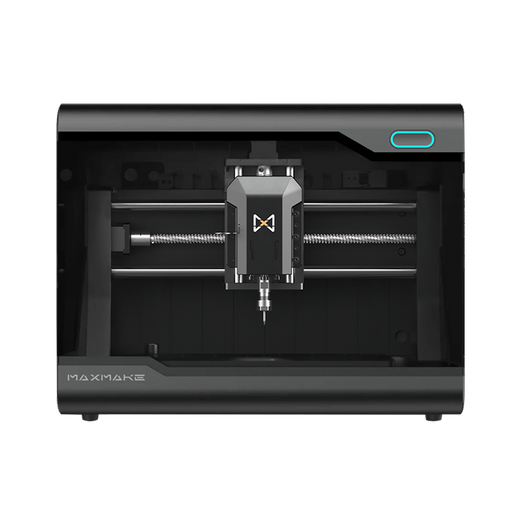
HiMill D1 Desktop CNC Machine
Connect with the MAXMAKE community
Share your projects, discover new ideas, and connect with other makers.
Join Our Community
Share projects, ask questions, connect with makers