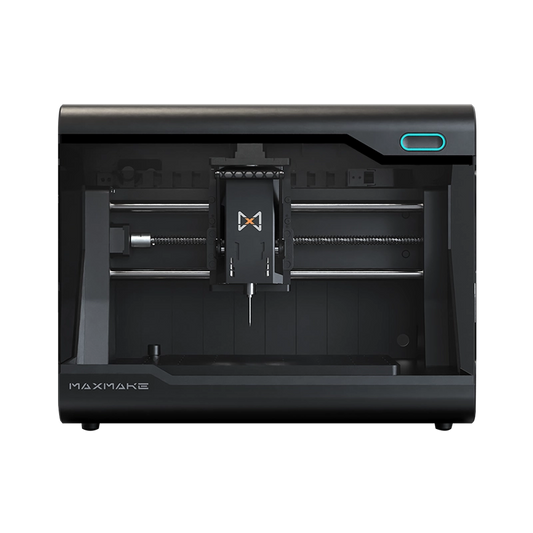
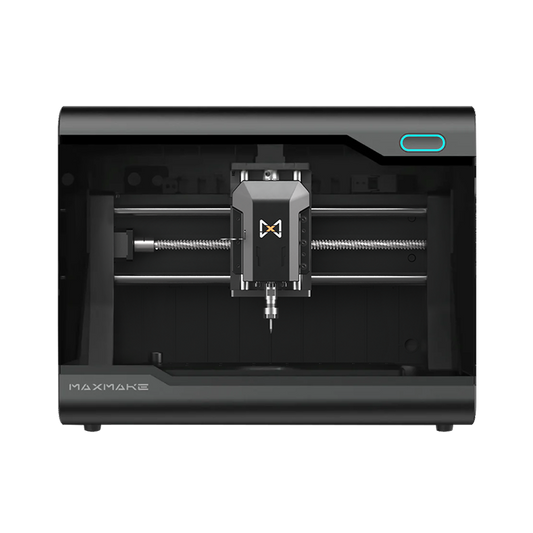
DIY Battery-Free Wooden Passive Amplifier: Crafted with HiMill D1S Desktop CNC📱🔊
Imagine a speaker that requires no Bluetooth, no batteries, and zero power supply—ever. Today, I’m taking the HiMill D1S Desktop CNC for a spin to create a "Natural Acoustic Amplifier" carved entirely from premium solid wood.
By leveraging the principles of acoustic resonance, this project doesn't just boost your smartphone’s volume by 10dB+; it enriches the audio, giving it that warm, "analog" soul. Here is how a simple block of wood transformed into a high-end desktop subwoofer.
🛠️ Project Overview
- Project Name The "Timber-Tone" Passive Acoustic Dock
- Equipment HiMill D1S Desktop CNC
- Core Principle Helmholtz Resonance + Horn Amplification
- Highlights 100% Passive, Vintage Grill Aesthetic, Enhanced Audio
- Difficulty ⭐⭐⭐ (Precision Focus)
- Machining Time Approx. 8 Hours
- Materials Black Walnut + Beech (Laminated)
📋 1. The Science & Material Selection
Why wood? This isn't just a stand; it’s a meticulously designed "Acoustic Labyrinth." When the sound leaves your phone's speaker, it enters an internal chamber where it is reflected and compressed through a calculated curve, then projected out of the front grill.
Bill of Materials (BOM):
The Wood: I highly recommend high-density hardwoods like Black Walnut, Cherry, or Rosewood.Hardwoods reflect sound much better than softwoods.
Construction: I used the "Sandwich Method"—stacking multiple layers.
Hardware: Neodymium magnets for a satisfying "snap" fit.
Finish: High-quality Wood Wax Oil.

💻 2. CAM Strategy: Engineering the Perfect Chamber
To machine the complex internal channels, I split the CAD design into three distinct layers.
Step 2.1 Internal Pocketing (The Sound Path)
- The Secret: The internal walls must be smooth. Any rough tool marks will absorb sound waves.
- HiMill D1S Settings: 3.175mm (1/8") Single Flute bit, 0.2mm roughing allowance, and a fine finishing pass.
Step 2.2 The Vintage Front Grill
- The Challenge: The grill slats are incredibly thin and prone to snapping.
- The Solution: Feed Rate dialed back to 800 mm/min. Swapped to a 1.5mm micro-diameter bit. The HiMill D1S handled this beautifully—clean lines, zero burrs.

⚙️ 3. The Machining Process
Time to let the HiMill D1S do the heavy lifting:
- Core Layers: Milling the winding "horn" or "trumpet" shaped channels.
- Top & Bottom Plates: Precision cutting the phone slot and the sleek outer silhouette.
- The Faceplate: Fine-carving the retro-style acoustic output grill.
🧩 4. Assembly: The "Sandwich" Joinery
This is where the acoustic magic comes together.
- Alignment: Press-fitting the magnets into the pre-milled pockets.
- Glue-up & Sanding: Using locating pins for perfect alignment, followed by a thorough sanding to unify the layers.

🎨 5. Finishing & Sound Test (+10dB Challenge)
- Sanding: From 240 to 600 grit for a silky finish.
- Oiling: Applying wood wax oil to make the Walnut and Beech deepen into a rich glow.
- Performance: Before (thin/tinny) vs After (focused, warmer, and significantly louder).
- The Data: Consistent boost of 10-15dB.

🎉 6. Final Thoughts
This HiMill D1S-built acoustic speaker is the perfect marriage of Modern Tech and Timeless Nature. Whether you’re camping or working at your desk, you’ll never deal with a "Low Battery" warning.
If you appreciate the romance of the 'Analog Era,' download the files below and build your own!

📥 Download the Files
Grab the CNC project files here and start carving!
Download Speaker_Project.zip
HiMill D1 Desktop CNC Machine
Connect with the MAXMAKE community
Share your projects, discover new ideas, and connect with other makers.
Join Our Community
Share projects, ask questions, connect with makers